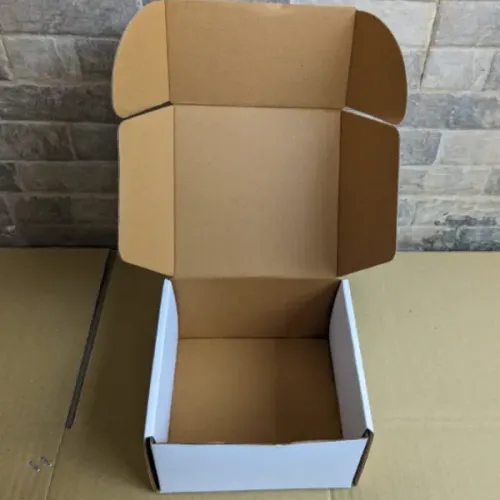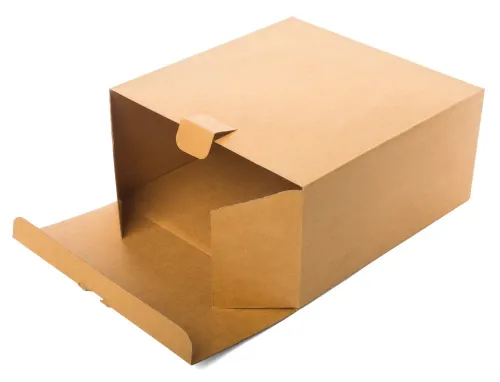
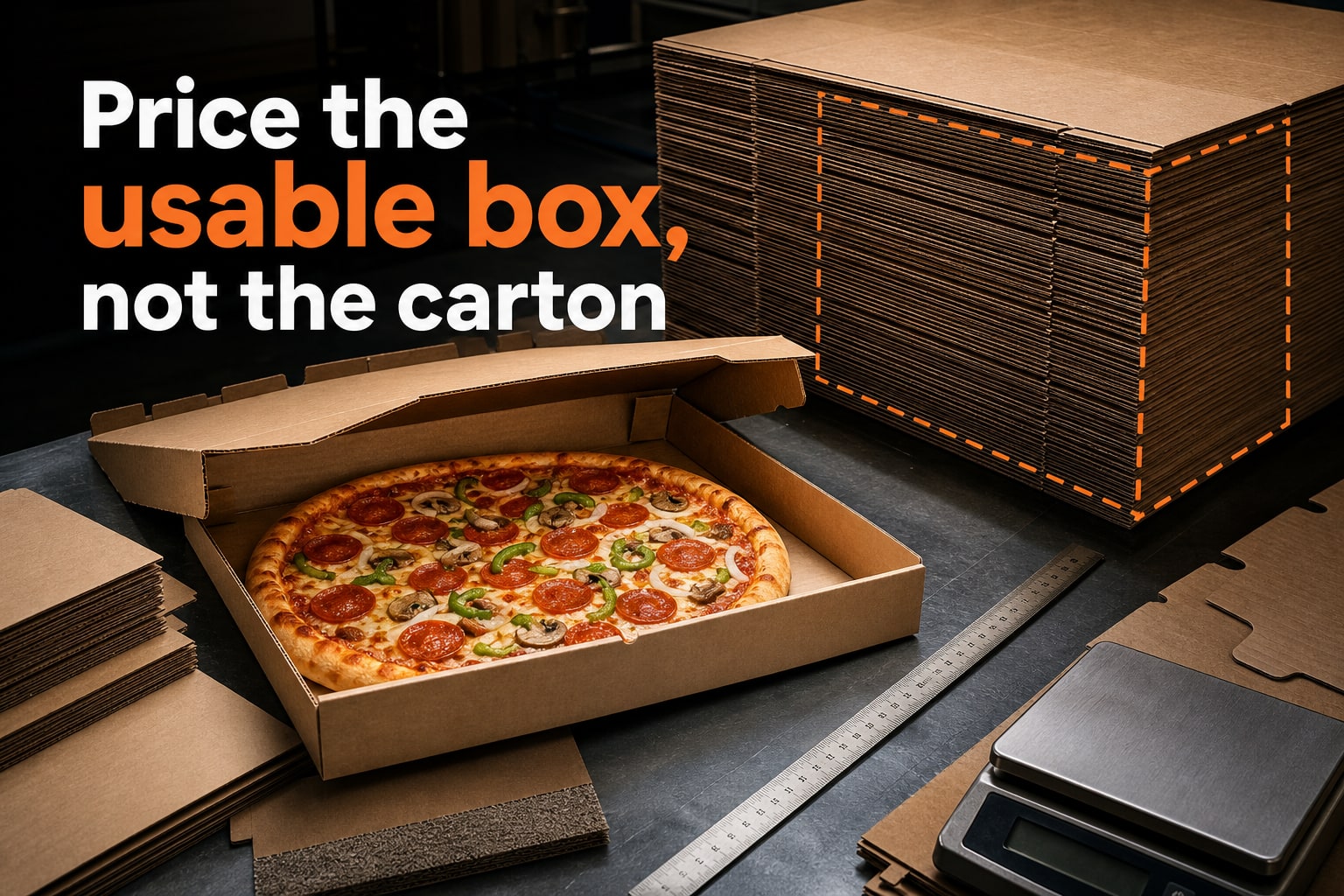
A nominal 12-inch box can have less than 12 inches of usable space, while a box that fits the pizza can still fail under steam, grease, stacking or delivery pressure. By the end, you will know how to specify the box, calculate a sensible order quantity, compare landed quotations and approve a custom run without paying for unsuitable packaging.
Key takeaways
- Measure the finished pizza, then add clearance for toppings, crust, and sauce.
- Ask suppliers for board construction details and food-contact documentation.
- Compare landed cost per usable box, not the carton price alone.
- Approve a trial sample before committing to a repeat wholesale order.
Measure the pizza and choose the usable internal size
Select the box from its usable internal length, width, and height—not the printed pizza size. Measure the finished pizza at its widest point, including crust overhang and toppings, then add side-to-side clearance so the rim does not scrape cheese or sauce.
A nominal 12-inch pizza therefore needs an internal width and length greater than 12 inches.
For pizza boxes wholesale for restaurants, record the actual internal dimensions on the order and check the height against the tallest format. Thick crusts, extra cheese, calzones, and raised lids need more headroom than a flat, thin-crust pizza.
| Box size | Suitable starting use | Check before ordering |
|---|---|---|
| 7 x 7 in | Small personal pizza or individual slice | Confirm the slice width and crust overhang |
| 8 x 8 in | Personal pizza or small square pizza | Measure toppings and side clearance |
| 9 x 9 in | Larger personal or compact square pizza | Check the finished diagonal on square formats |
| 10 x 10 in | Small square pizza, calzone, or multiple slices | Confirm height and closure clearance |
| 12 x 12 in | Small round pizza or larger square pizza | A 12-inch round pizza needs more than 12 inches of usable width |
A square pizza must fit both internal dimensions; measure corner-to-corner if the box has an angled closure. A calzone needs height for filling, while slices need enough width to prevent the pointed end from touching the lid.
Before approving a wholesale run, test production samples with the actual hot pizza, holding time, stacking pattern, and delivery route. Steam can soften the bottom and prevent a lid from closing cleanly even when the dry box fits.
Specify depth, board construction and food-contact evidence
Require the supplier to state the finished internal height, board grade, flute profile, basis weight, caliper, and grease-barrier treatment. Depth must clear the crust and toppings without forcing the lid upward; excessive headspace lets the pizza slide during delivery.
1. Ask for the complete construction specification. For custom pizza boxes with logo, identify the paperboard, corrugating medium, coating, adhesive, and printing inks. Record whether the board is single-wall or another construction, then check compression and bottom-sag performance after exposure to steam and grease.
2. Run a production sample using the actual pizza, sauce, cheese, toppings, holding time, delivery container, route, and stacking pattern. Check lid closure, venting, grease migration, bottom sag, odour or ink transfer, print scuffing, and clean opening after hot-food condensation forms. A dry box can look strong and still soften during service.
3. Request a food-contact compliance declaration covering the complete finished box, not only the paperboard. For United States use with aqueous or fatty foods, ask how the construction meets 21 CFR 176.170 and request the supplier’s current supporting documentation.
4. Ask for a current PFAS statement when a fluorinated grease barrier was intentionally added, and name the market where the box will be sold. Treat grease resistance and compostability as separate claims: require evidence for the disposal or composting requirement because fiber content alone does not prove compostability.
Calculate the order quantity and landed cost
For pizza boxes wholesale for restaurants, order enough for supplier lead time plus safety stock, then round up to full cases. Do not choose a pallet only because its unit price is lower; excess inventory can occupy valuable dry storage, absorb humidity, or arrive crushed.
- Record average boxes used per day by size and format. Multiply each figure by the supplier’s quoted lead time in days.
- Add safety stock for demand spikes and delivery delays. A practical starting point is one week of use, then adjust it from your order history.
- Add the two figures and round up to the supplier’s case pack. Check the resulting case count against pallet quantity, pallet footprint, height, maximum stacking, stretch-wrap, and corner protection.
- Confirm that the warehouse can keep the cases dry, off the floor, and away from leaking pipes or steam. Corrugated boxes lose strength in moisture before damage is obvious.
- State the required inside length, width, and height on the purchase order. Include the measured pizza, crust, toppings, side items, and clearance; a nominal “12-inch” label is not a usable-dimension guarantee.
Compare landed cost, not the quoted box price alone. Include the following:
- Box price by case
- Artwork, plate, digital setup, or print-run charges for custom boxes
- Freight, fuel surcharge, delivery, unloading, and applicable tax
- Receiving labour and storage space
- Expected damage, moisture loss, and obsolete stock
Divide the total by the number of usable boxes received. A cheaper pallet loses its advantage when it leaves you with damaged cases or months of unused inventory.
Compare stock boxes with custom printed production
Stock boxes are the safer choice when your volume is modest, artwork changes frequently, or the box only needs to protect the pizza. Custom printing earns its setup cost when the same design will run repeatedly, the logo supports brand recognition, or an unprinted box creates a labelling and presentation problem.
| Option | Main cost and trade-off | When it earns its place |
|---|---|---|
| Stock corrugated box | Lowest setup burden; limited branding and fixed format | Use for testing demand, several pizza sizes, or changing promotions |
| One- or two-colour print on a standard die | Artwork and print setup; lower tooling and waste than a new structure | Use when you want a logo without changing the box shape |
| Custom die or full-coverage print | Tooling, setup, production waste and higher minimum order | Use when the closure, ventilation, stacking strength or visual identity solves a real operating problem |
Ask the supplier to separate artwork preparation, plates or digital setup, minimum quantity and production-run charges. Confirm the printable panels, colour count, ink system, registration tolerance, and whether the logo sits on kraft or bleached liner.
A quote for custom product boxes wholesale can describe paperboard folding cartons or corrugated boxes; specify corrugated liner and fluted medium for hot, greasy food.
When comparing Packbox.In stock pizza boxes with a custom quote, treat the stock box as your cost and fit benchmark. Custom pizza boxes with logo justify their minimum only when repeat orders, brand value or a required format outweigh that benchmark. Lock the approved proof, board grade, dimensions and artwork revision process into the order.
Related products
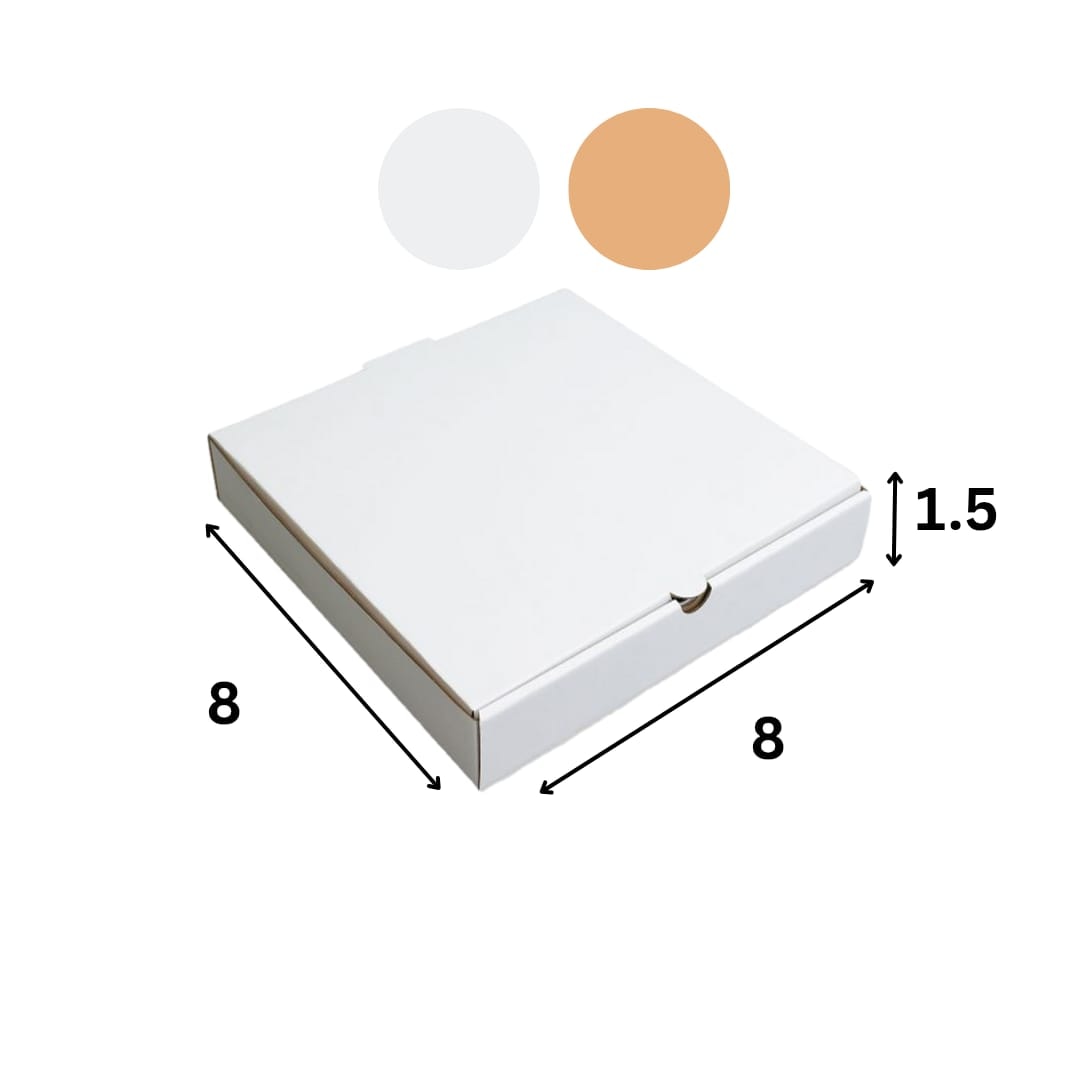 | PIZZA BOX PIZZA BOX 8X8X1.5 ₹14 Our Pizza Boxes are designed to keep your pizzas fresh, hot, and intact during delivery or takeaway. |
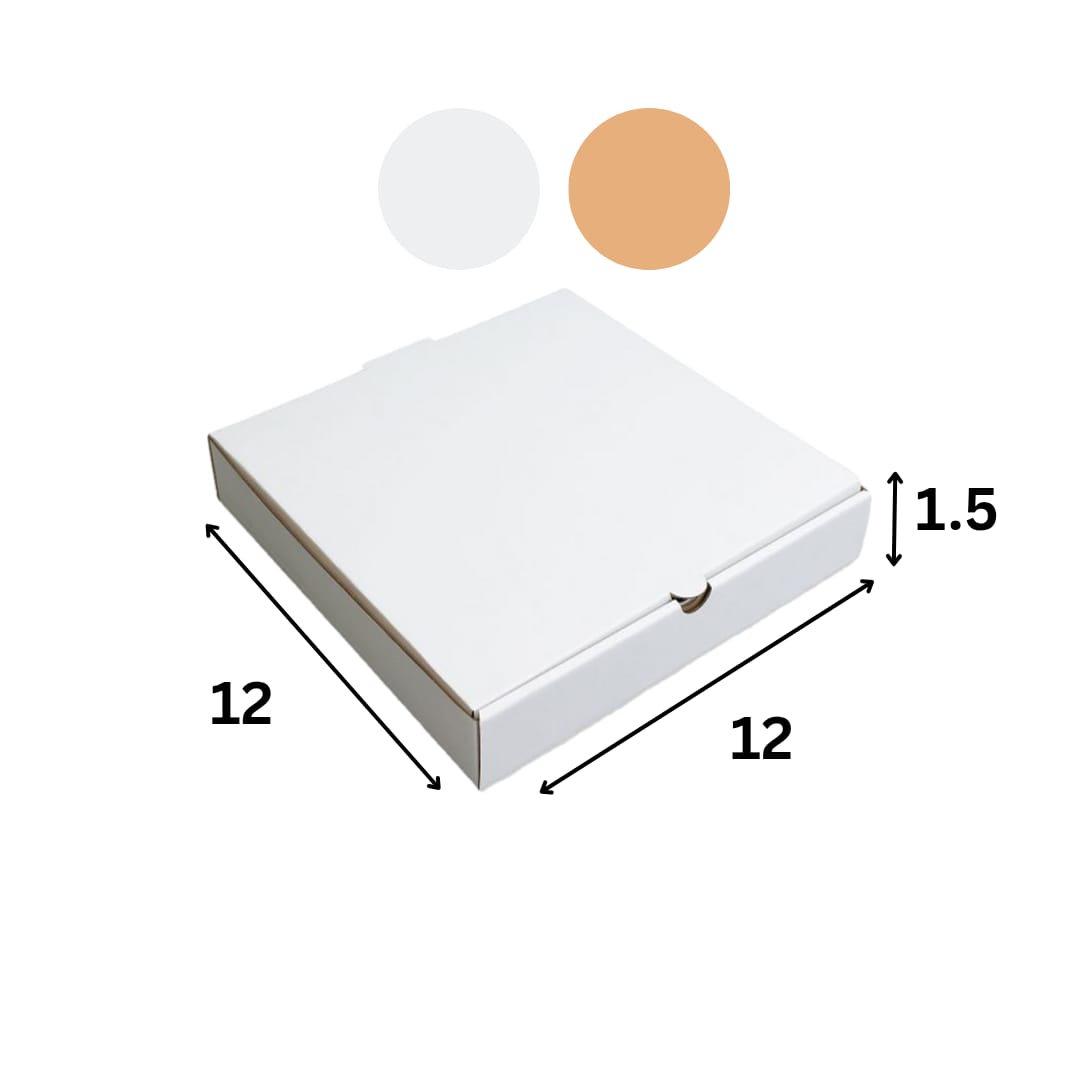 | PIZZA BOX PIZZA BOX 12X12X1.5 ₹30 Our Pizza Boxes are designed to keep your pizzas fresh, hot, and intact during delivery or takeaway. |
Approve the trial and control every repeat order
Approve a custom run only after a production sample survives service under real conditions. Use the actual pizza, sauce, cheese, toppings, holding time, delivery container and stacking pattern—not an empty box on a desk.
1. Record lid closure, bottom sag, grease migration, venting, condensation, odour or ink transfer, print scuffing and clean opening after the pizza has cooled. Reject the sample if the lid springs open, the base weakens, or the print rubs onto food.
2. Confirm the physical specification against the approved sample: single-wall or double-wall construction, flute profile, liner and medium grades, board caliper, ECT or burst rating, dimensions, closure style and case-pack quantity. ECT helps assess stacking; neither ECT nor burst rating proves grease or moisture resistance.
3. Identify the substrate on the purchase order. “Custom product boxes wholesale” can mean folding paperboard cartons or corrugated boxes, and those materials differ in compression, print finish and suitability for hot, greasy food.
4. Lock the approved artwork proof, print colours, tolerances and revision number into the contract. Require written notice before any change to the liner, flute, closure, dimensions or logo.
5. Repeat the same trial when a specification, artwork version or supplier changes, then retain a signed sample and inspection record for every recurring order.
For wholesale corrugated cartons for retailers, specify whether the carton ships goods or sits shelf-ready: add tear-open features, barcode position, display stability and case pack. Subscription box packaging wholesale needs its own carrier, zone, packed-weight, dimensional-weight, drop, vibration, return and machine-packing requirements; a pizza-style closure is not automatically suitable.
Frequently asked questions
How do restaurants choose the correct pizza box size?
Measure the finished pizza at its widest point, including crust overhang and toppings. Choose the usable internal length and width with enough side clearance to prevent the rim from scraping cheese or sauce.
What should restaurants specify when ordering pizza boxes wholesale?
Specify the internal depth, board construction, flute or paperboard grade, closure style, ventilation features, and food-contact evidence. Ask for documentation identifying the material and confirming suitability for direct food contact.
How do restaurants calculate the true cost of wholesale pizza boxes?
Multiply the unit price by the order quantity, then add printing, tooling, freight, taxes, storage, and delivery charges. Divide the total landed cost by the number of usable boxes after rejecting damaged stock.
Should a restaurant choose stock boxes or custom printed pizza boxes?
Choose stock boxes for immediate availability, low commitment, and changing demand. Choose custom printed production when brand visibility justifies the minimum order, artwork approval, tooling, and longer lead time.
Related products
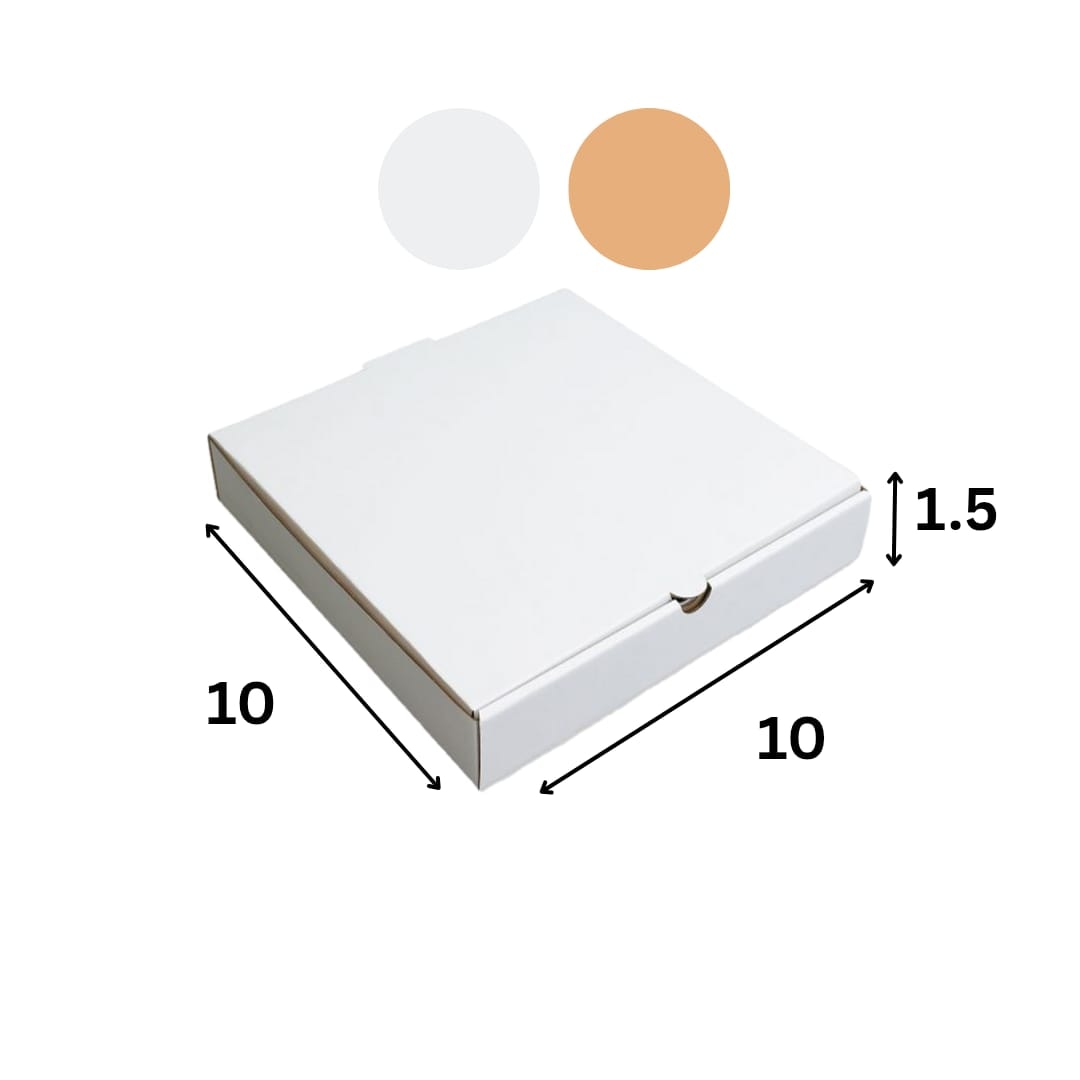 | PIZZA BOX PIZZA BOX 10X10X1.5 ₹20 Our Pizza Boxes are designed to keep your pizzas fresh, hot, and intact during delivery or takeaway. |
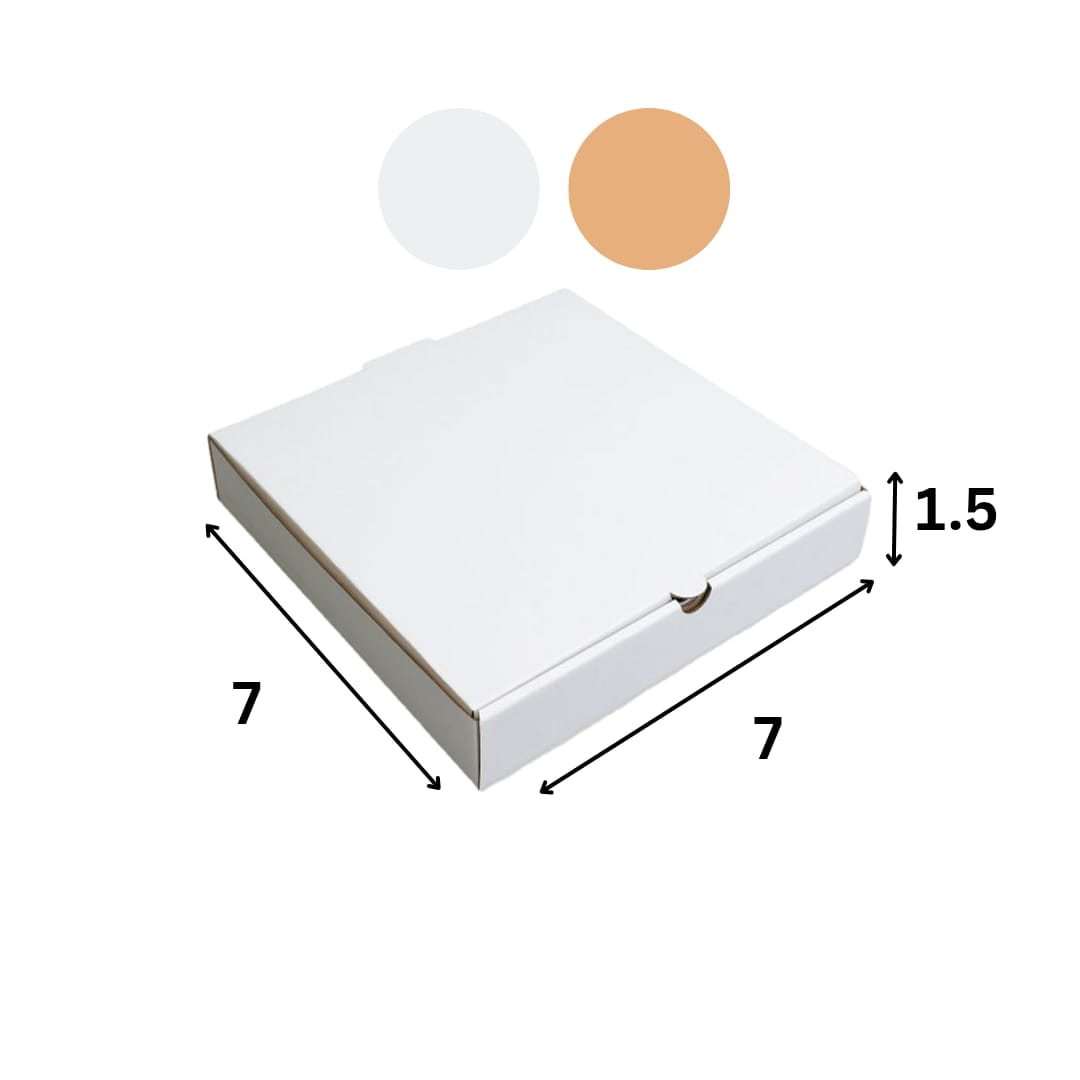 | PIZZA BOX PIZZA BOX 7X7X1.5 ₹12 Our Pizza Boxes are designed to keep your pizzas fresh, hot, and intact during delivery or takeaway. |
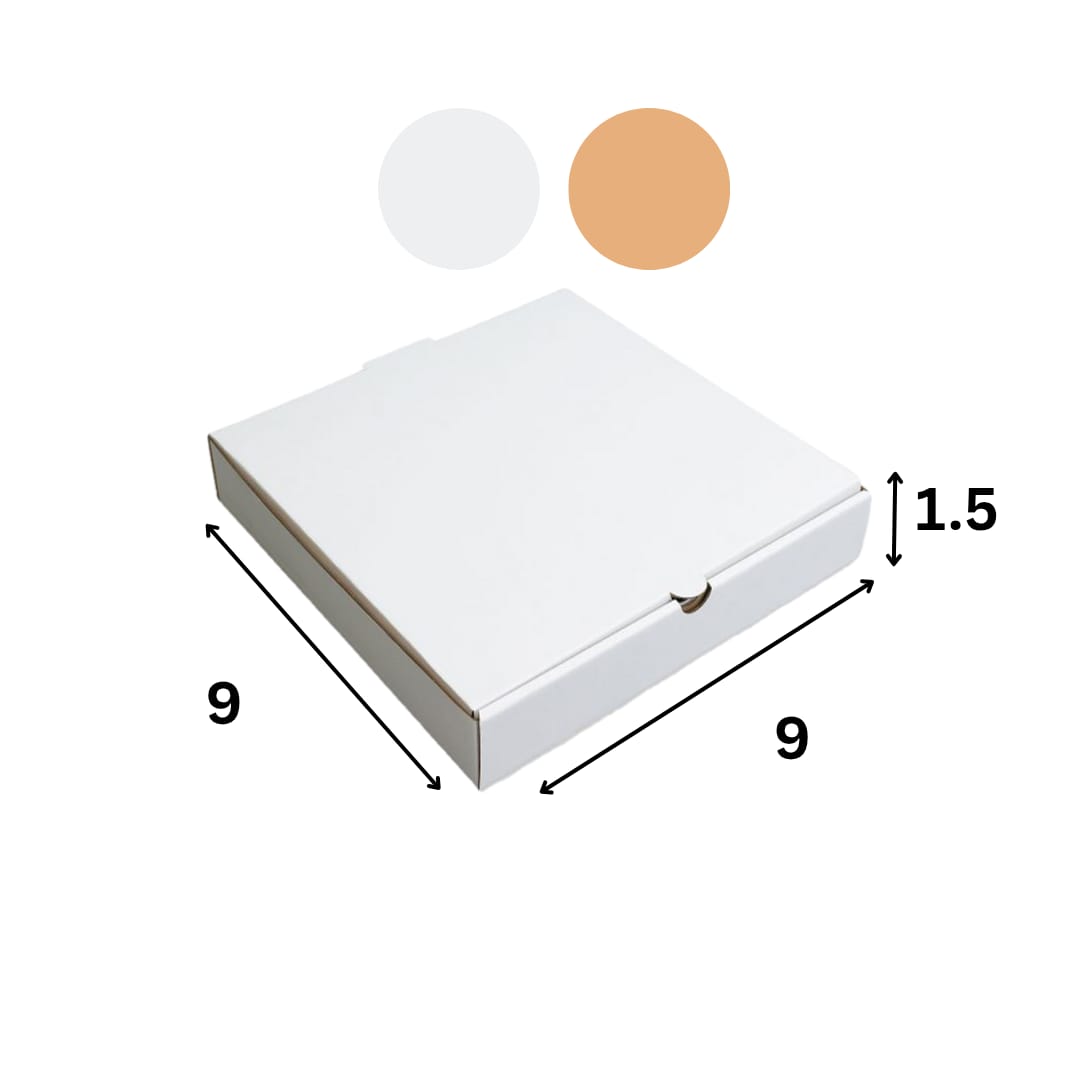 | PIZZA BOX PIZZA BOX 9X9X1.5 ₹14 Our Pizza Boxes are designed to keep your pizzas fresh, hot, and intact during delivery or takeaway. |
Keywords